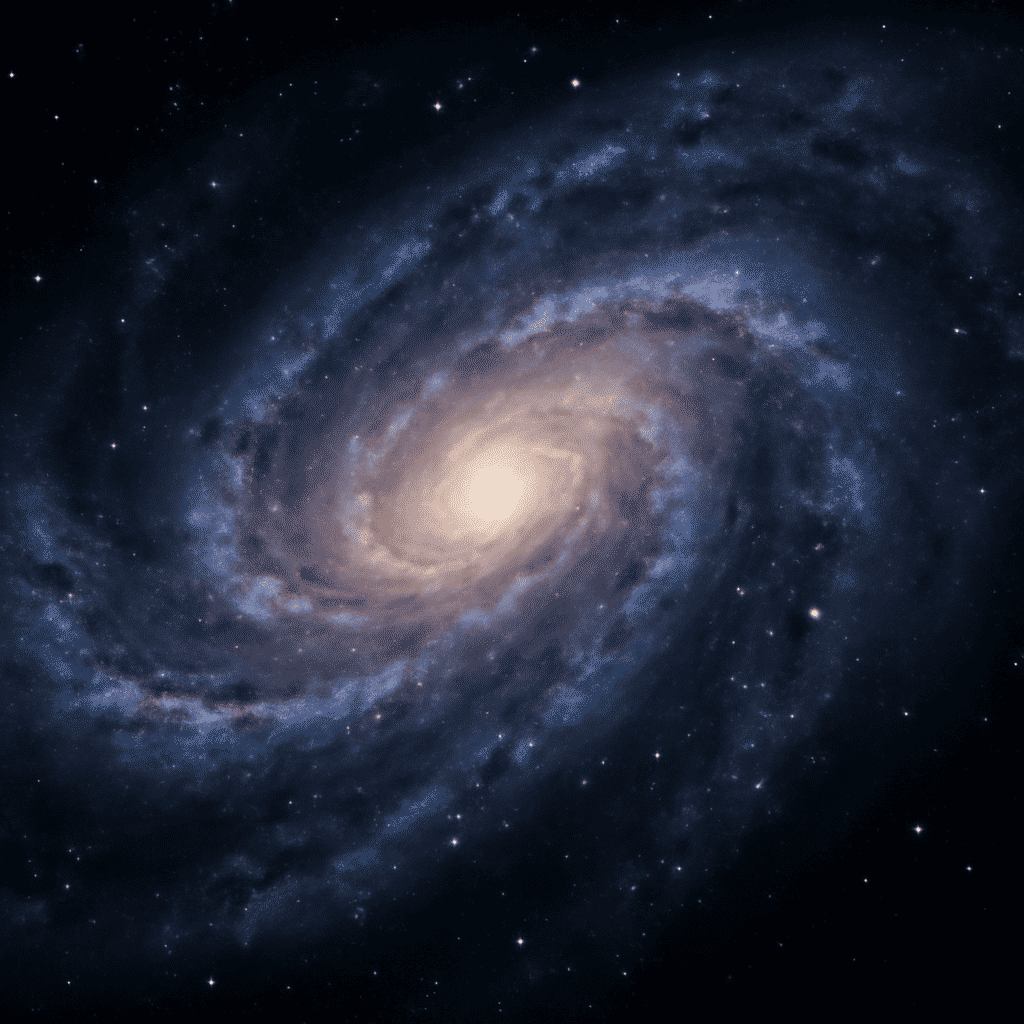
In recent years, the veil shrouding the enigmatic presence of dark matter in our universe has been lifted ever so slightly, thanks to groundbreaking discoveries that are reshaping our understanding of fundamental physics. Though it accounts for approximately 27% of the universe's mass-energy content, dark matter remains one of the most elusive subjects in modern astrophysics. Traditional theories have long struggled to explain its composition and behavior, but emerging insights are beginning to illuminate the cosmic shadows where this mysterious form of matter resides.
One of the pivotal advancements comes from observations made by cutting-edge telescopes and satellite missions. With instruments like the European Space Agency's Gaia spacecraft and NASA's Hubble Space Telescope, astronomers have been able to map the distribution of dark matter with unprecedented precision. These observations have revealed that dark matter forms a complex cosmic web, sculpting the large-scale structure of the universe. Intriguingly, the distribution is not as uniform as previously thought, suggesting dynamic interactions that challenge older models of dark matter as a mere passive background tapestry.
Complementing these observational breakthroughs, experiments on Earth are diving into the quantum realm to search for dark matter candidates. The Large Hadron Collider (LHC) at CERN, operating at the frontier of particle physics, has been pivotal in probing the existence of weakly interacting massive particles (WIMPs), one of the principal contenders for dark matter. Though WIMPs have yet to be directly detected, the negative results have been just as informative. They have helped refine theoretical models, narrowing the range of viable mass and interaction cross-sections for these elusive particles.
In addition to WIMPs, other theoretical propositions are gaining traction. Axions, hypothetical particles with extremely low mass, have emerged as a promising alternative. Experimental setups such as the Axion Dark Matter Experiment (ADMX) are tailored specifically to detect these particles, and their potential discovery could revolutionize our understanding of dark matter. Even more avant-garde is the idea of primordial black holes as constituents of dark matter, a theory rejuvenated by recent gravitational wave detections that hint at a population of smaller and more numerous black holes than anticipated.
Astrophysical insights are also painting a new picture of how dark matter interacts within galaxies. Observations of galaxy rotation curves, which measure the velocity of stars and gas in galaxies, have long indicated the presence of dark matter halos. However, the newer high-resolution spectroscopic data suggest complexities beyond the simplistic spherical halo model. Notably, the formation and behavior of dwarf galaxies—rich in dark matter and less influenced by baryonic matter—are becoming major testing grounds for dark matter theories.
While these discoveries and experiments foster hope for breakthroughs, they also underscore the limits of existing paradigms. The standard model of cosmology, which neatly packages dark matter within the Lambda Cold Dark Matter (ΛCDM) framework, is being stretched by these novel findings. The observed small-scale discrepancies and rich structural nuances invite fresh theoretical frameworks, potentially involving modifications of gravity or even new fundamental forces.
Despite the vast strides made, dark matter remains a puzzle piece not entirely fitting into the cosmic jigsaw. Yet, piece by piece, as data mounts and our instruments become more sophisticated, the outlines of a new picture begin to form. New theories and technologies may soon illuminate the dark recesses of our universe, finally revealing the secrets of the universe’s hidden mass and possibly unlocking unprecedented chapters in our cosmic narrative.